

The Self-Publishing to Traditional Publisher Deal Surge of 2025: Who Got the Deals, How It's Already Slowing Down in 2026
And why this isn’t a promising path to getting your novel published


For many years it was a truth universally acknowledged that a traditional publisher did not want to acquire a book that had already been self-published.1 But 2025 seems to have rewritten this rule.
Anyone who’s been following traditional fiction acquisition deals can tell you 2025 was a huge year for self-published authors. It seemed like self-published authors were constantly getting snapped up by Big 5 publishers.
And it’s true this was a more frequent occurrence in 2025 than we’ve seen in any previous year. According to Publishers Marketplace, in 2025 traditional publishers announced 66 fiction deals2 with self-published authors, whether to re-publish a successfully self-published novel, or to publish a new novel by a previously self-published author. The 2025 fiction deals with self-pubbed authors showed a 154 percent increase over 2024, which had only 26 of these types of deals reported.
However 66 is merely the total deals announced. Almost 50 percent of these deals (32 total) were for multi-book deals, resulting in a whopping total of at least3 131 books. And, that’s only counting the Publishers Marketplace deals that mention an author’s self-published history.
It’s an even more shocking increase when you consider just 4 years before in 2021 a measly 4 fiction deals with self-pubbed authors were announced for the year, which was pretty much the norm.
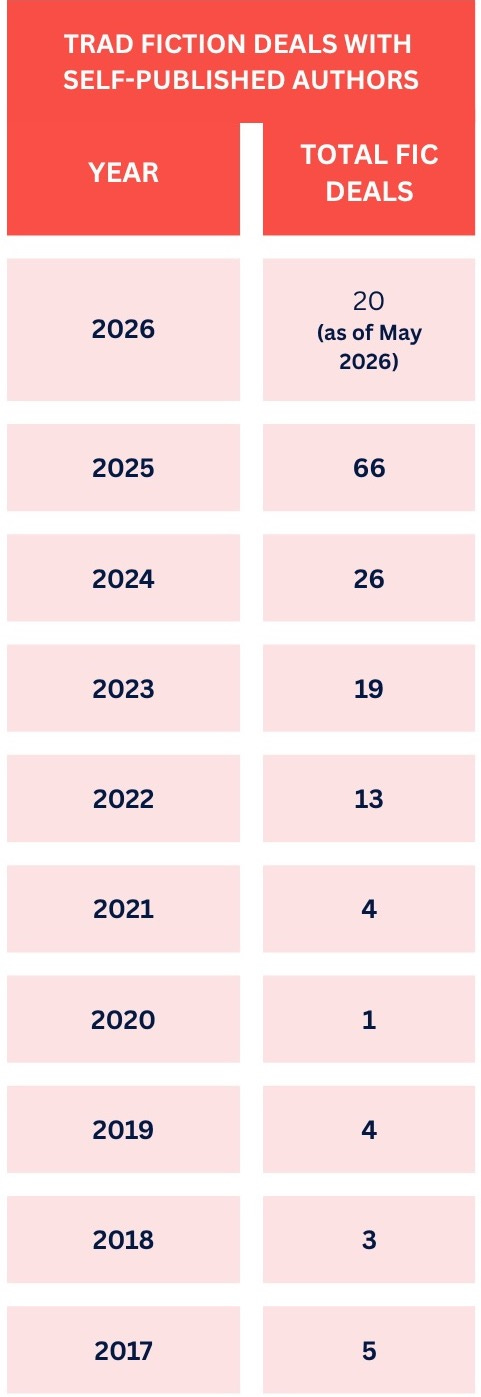
Of course we’re not quite halfway into this year, so it’s too early to tell if 2026 will keep pace, but last year at this time there were 32 deals announced with self-pubbed authors, and as of today there’s only been 20, which means we’re already down 38 percent. Although 12 of those deals are two- or three-book agreements.
Perhaps we’ll see more growth in 2026, but I suspect last year’s Shy Girl controversy and all the uncertainty around AI has made publishers more cautious. We’re clearly not returning to the low numbers of 5 years ago, but I also think we’ll continue to see a slowdown in these types of deals.
But if you take nothing more away from this analysis, remember this: while it’s true 2025 was an astonishing year for self-published authors snagging traditional deals, of the total 2025 fiction deals, those involving self-published authors only made up 3 percent.
In other words, 97 percent of the fiction deals were acquired via agent submission or, when allowed, direct submission by the author. That route is still an author’s most likely path to trad publishing.
Which self-published genres were publishers scooping up?
Unsurprisingly Romance deals dominated with Romance books accounting for nearly half of the 2025 deals, and Romantasy4 nearly a third. Though I’ve kept the genres in the below table consistent with their reported PM category, the Romantasy numbers actually increase slightly, as one of the titles labeled as Debut is also Romantasy, and the single title labeled New Adult is a Romance.
The 2026 genre trends follow last year’s deals with Romance and Romantasy leading the way, and Thriller, Horror and Sci/Fi Fantasy making minor appearances. The one 2026 Debut title is also a New Adult Romance.
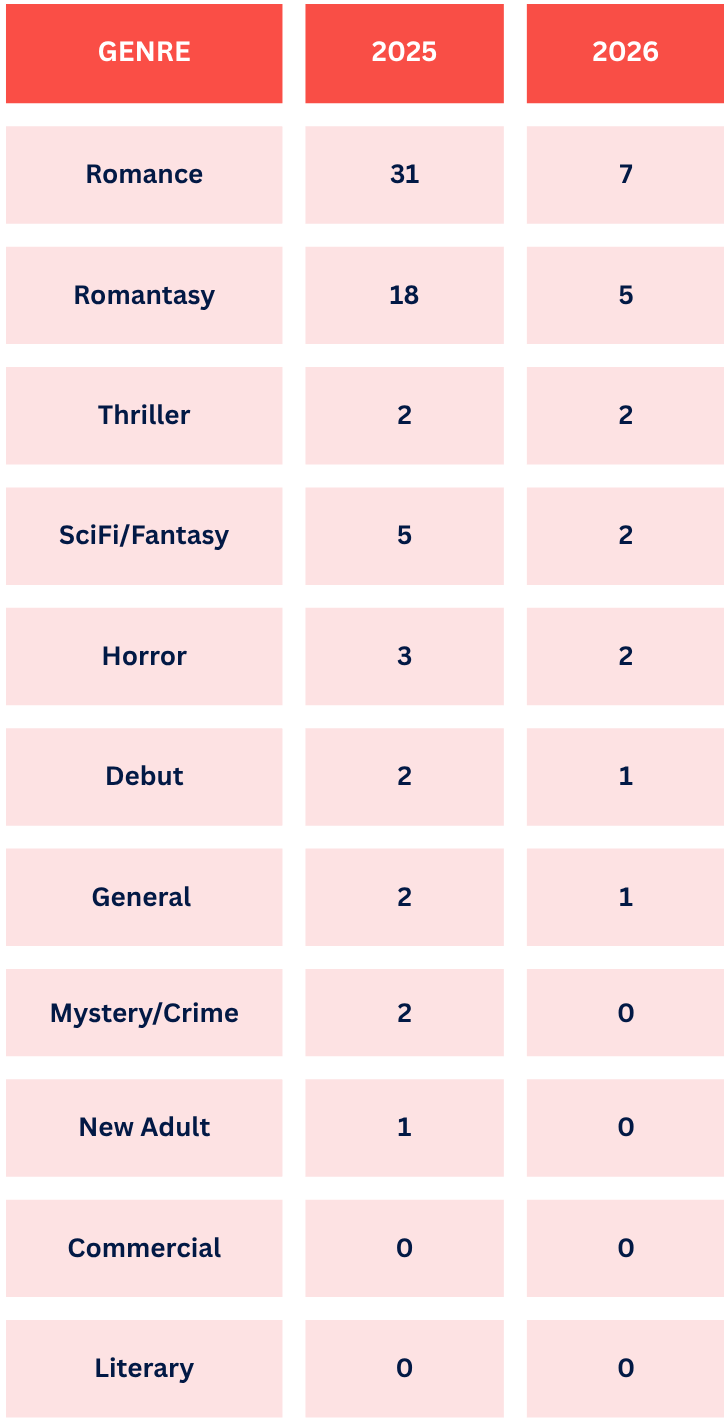
In 2025, Romance also dominated the multi-book deals with Romance (15 deals) or Romantasy (10 deals) accounting for nearly 80 percent of these. Two-thirds of 2026’s multi-book deals to date are either Romance or Romantasy (8 total) but there were also 2 Horror multi-book deals and one each for SciFi/Fantasy and Thriller.
What about Women’s Fiction, Upmarket and Book Club Fiction?
It’s true Women’s Fiction, Upmarket or Book Club Fiction are genres that have not traditionally fared well in self-publishing. And these genres are largely absent from the 2025-26 deals with self-published authors.
Although PM no longer recognizes Women’s Fiction as a category, and has never categorized Upmarket or Book Club, these titles usually fall under Debut, General, Commercial and sometimes Literary.
There are a few exceptions I see that do align with these genres. The first is Pamela Kelley’s books, which are likely to be categorized as Women’s Fiction as the first one in this series already is.
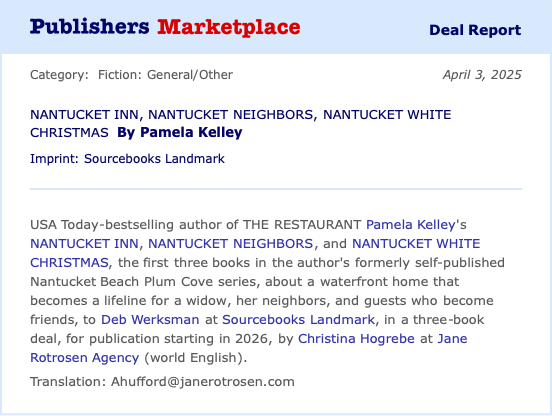
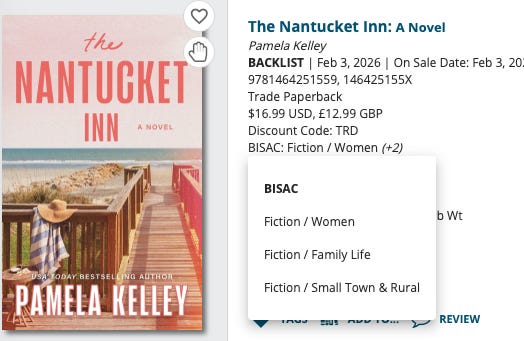
However, Ms. Kelley was already an established best-selling author with both traditional and self-published titles to her name, so she’s not a fair comparison for a women’s fiction writer who has yet to publish a title.
Two more notable exceptions: First author Kimberly Burns’s three originally self-published, stand-alone historical fiction books acquired by small press, Hat Creek. Set in 19th-century Colorado, these titles fit nicely into their Western and historical fiction niches.
Second, Naomi Kanakia’s story collection, The Payoff, which was based on her self-published novella and categorized as General, and I suspect will ultimately be categorized as Literary. But it’s a story collection, not a novel.
The self-published book that defied all publishing odds
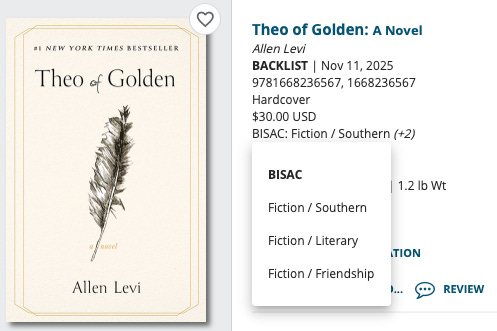
An especially surprising break-out seller is a book you’ve surely heard of as much for the book’s popularity as for its seemingly fairy tale trajectory: the self-published Theo of Golden by Allen Levi was acquired by Atria Books last fall and became a #1 NYT bestseller.
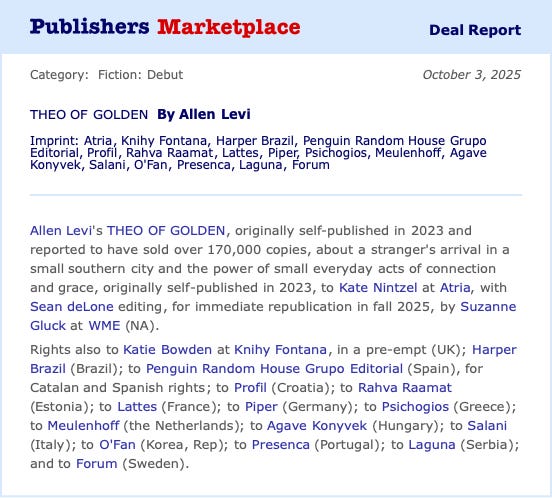
The most surprising thing about this is not that it sold over 170,000 copies before the acquisition, largely via word of mouth. It’s not even that the first-time author didn’t have a platform or large marketing budget or even ambitions to be an author. (He simply set out to see if he could write a book.)
The most surprising thing, in my opinion, is this hugely successful best-selling novel doesn’t fit any of the typically successful self-publishing genres. Instead Theo of Golden is what we often call a “quiet story,” and has been categorized by the publisher as both Southern Fiction and Literary. The latter is how we often see Upmarket or Book Club fiction categorized. (Because there’s no BISAC code for Upmarket or Book Club Fiction.)
If you follow any of the publishing maxims, Theo of Golden had no business selling tens of thousands of self-published copies let alone becoming a NYT bestseller.
And yet somehow it did.
It’s incredibly inspiring when we see stories like this, but it’s also important to keep in mind these stories are the exception to the rule. We can’t rule these things out, but you simply can’t count on a trajectory like this.
What does all this mean for writers?
I started tracking these deals early in the year as I was curious if the 2026 self-publishing acquisitions were going to mirror 2025. But this felt even more important recently as I started hearing and reading a lot of frustration from writers who are feeling demoralized by how seemingly difficult it is to break into trad publishing right now. This has been discussed at length by author and industry expert Karin Gillespie here (paywalled) and literary agent Vicky Weber here and writer and former literary agent Devon Halliday here.
Understandably some writers are reconsidering the pursuit of traditional publishing and wondering if self-publishing might be the best path forward.
And it might be.
But I also suspect some writers are seeing these publishing deals and thinking self-publishing is a viable route to traditional publishing.
And it’s simply not.
Because—while we’re seeing trad publishers embrace self-published novelists like never before—3 percent is still not strong odds.
I don’t say this to discourage anyone, but rather to empower you with more information. Writing a book is a business, and—no matter your path to publishing—you need to understand the industry to be successful.
Self-publishing is a totally valid publishing path, and one that can be very empowering. But it’s important to choose self-publishing for its specific benefits—more control, for example, and, sometimes if you’re fortunate, more money. If you get offered a trad deal5, that may be a bonus but it shouldn’t be the end goal.
This is especially true because self-publishing a book is not an easy publishing path. Many writers recognize they’ll have to do their own marketing, but they don’t always realize what’s involved in overseeing production and distribution and just learning to navigate the publishing industry.
In the coming weeks I’ll be sharing an interview with a self-published author who has built a successful career and business for herself. But it hasn’t been easy. She not only writes engaging, well-crafted books, but also manages marketing, production, distribution, and even negotiates her own subsidiary rights. She’s incredibly busy and hard working, and her path is not one that every writer will enjoy.
I’m looking forward to sharing her experiences because it’s important to not only know that self-publishing is a viable path, but also to have enough information to understand if it’s the right publishing path for you.
Psst…also check out Q and A with NYT Bestselling Author Turned Self-Publisher and Upmarket, Literary, Thriller, Fantasy: Which Fiction Genre Topped Agent Requests and Publisher Acquisitions in 2025?

Hi! I’m Heather Garbo…I’m a certified book coach for women’s fiction writers (re)discovering their writing voices in midlife. My story planning, drafting and revision methodology empowers aspiring novelists to transform fledgling ideas and messy manuscripts into engaging stories…because no woman should regret not pursuing her creative dreams nor doubt the value of her voice. Learn how to work with me at www.garbobookcoaching.com.
It was inevitable I was going to make a Jane Austen reference eventually. I feel like I should apologize for the corniness, but I’m just not going to.
These deals specifically used the term “self-published” in the announcement.
Not all of the deals specified the total number of books or listed all the titles so it wasn’t easy to tell without additional research, which I didn’t want to do.
In PM, Romantasy is a recognized fiction category in deal announcements, however, it’s not currently listed in the genre dropdown menu. 🤷♀️
I also want to call out it’s not unheard of for self-published authors to finally get that traditional offer they’d always hoped for and then turn it down because it no longer aligns with their goals.
Great piece!
Great article, packed with info and insights. Timely, as well, given the subject matter of the still new dynamic that is the comingling of trad pub and self-pub. Still but a flicker, as you say, but there is life there, as one would expect there to be. Perhaps you’ll consider speaking with some agents and doing a piece like, “How to Pitch a Self-Published Novel to an Agent.” I wrote a piece last month on the traditional query process and how most industry observers should not be surprised that, given a chance, any chance, like self-pub, writers would take it. I also noticed that in your reply to a comment you mention how a lot of writers may not realize just how different marketing and promoting their novel is from writing it, which I’ve also written about. Interesting times for publishing. If one does not feel the change in the air, one must not be breathing. When it comes to the industry itself, there lots to write about. In fact, I also wrote an article about publishing in which I wonder why I’m writing so much about publishing.
https://brutusmac.substack.com/p/lot-of-bookfolk-out-there-reading?r=6aexdu